


২৮শে জুলাই, ২০২৬ খ্রিস্টাব্দ
সংস্করণ:

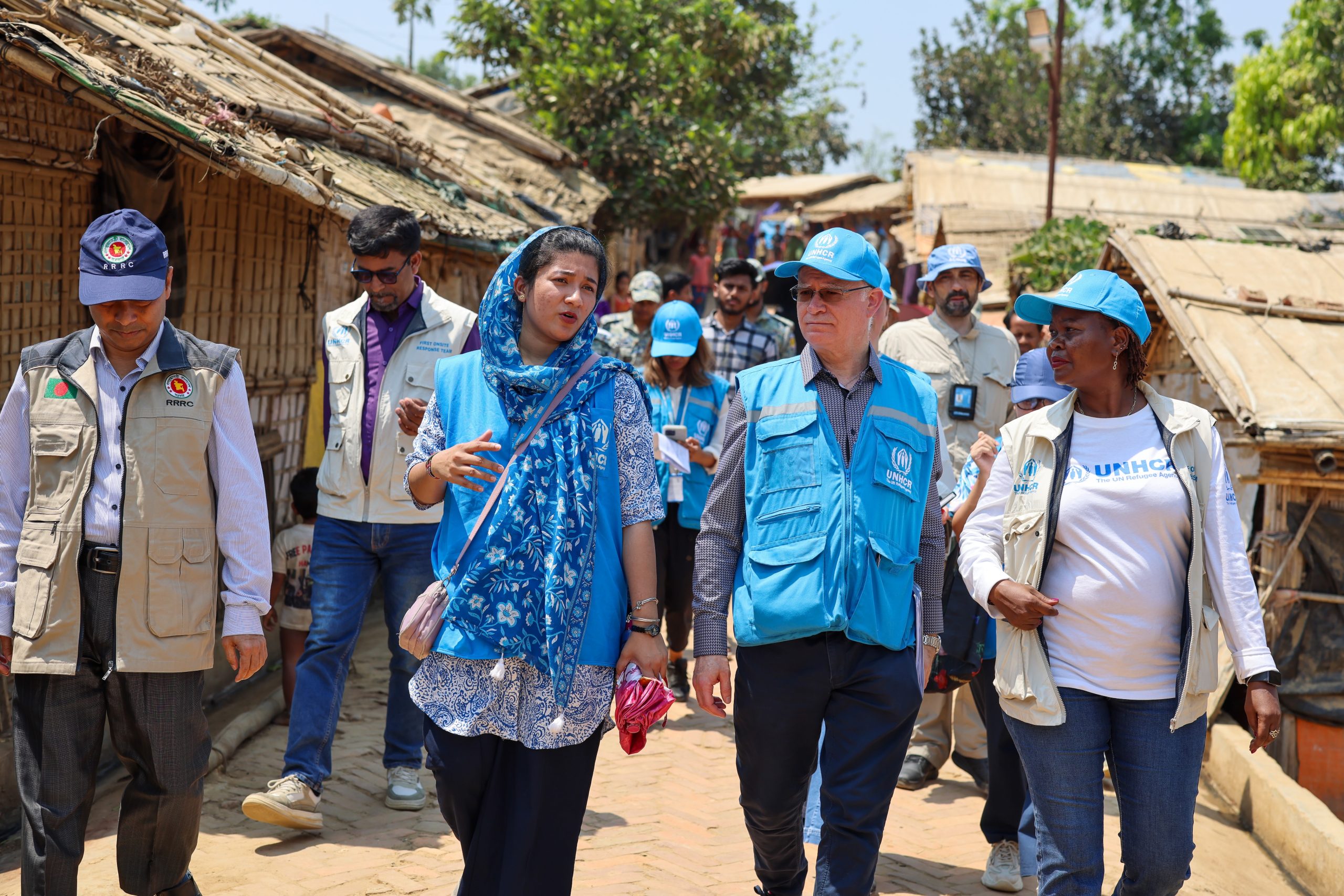
Press Release : Cox’s Bazar, 3 April 2025 – DHAKA – H.E. Marcelo Vázquez-Bermúdez, Permanent
Representative of Ecuador to the UN in Geneva and Chairperson of UNHCR’s Executive
Committee, underscored UNHCR’s steadfast commitment to supporting Rohingya refugees
in Bangladesh during his recent visit to the camps in Cox’s Bazar. He also highlighted the
criticality of the humanitarian response by UNHCR and its partners to address the complex
challenges faced by over a million refugees in Bangladesh.
During his four-day visit, Vázquez-Bermúdez witnessed firsthand the immense scale of the
humanitarian crisis—now in its eighth year— as he engaged with refugee groups across
different camps to understand their assistance needs and protection challenges. In Nayapara
camp, he heard from Rohingya who had recently fled targeted violence in Myanmar’s Rakhine
State.” The stories they told were heart-wrenching, with many including old men in tears as
they recounted their ordeals,” said Vázquez-Bermúdez. “I will ensure that these voices are
heard by Member States of UNHCR’s executive board, providing much-needed visibility to
their plight.”
In discussions with men and women community leaders in the Kutupalong area, Vázquez-
Bermúdez heard concerns about insecurity in the camps and fears over premature
repatriation in adverse conditions. Meeting with young refugees receiving English and
vocational training in a skills development centre in Teknaf, he saw signs of hope despite
tremendous difficulties. “These young people are eager to contribute and build a better
future, if given the opportunity,” he said.
He heard from the refugees about their strong desire to return to their homes in Myanmar,
when the conditions are in place: “They want to help build thriving, developed societies when
they go back, and we have to continue supporting them so they can fulfill their dreams.” At
the same time, he emphasized, “Sustainable peace and security in Rakhine are essential to
ensure they are not forced to flee again.”
Vázquez-Bermúdez expressed deep concern over the drastic reduction in funding that all
humanitarian partners are currently facing. “We must prevent a disaster,” he urged. “More
than 1 million Rohingya refugees are dependent on humanitarian assistance for the most
basic needs of food, water, cooking fuel, and shelter. States and other stakeholders must act
now to foster the self-reliance of refugees in Bangladesh, until it is safe for them to go back
to their homeland.” He praised the generosity of Bangladesh and the host communities, while
recognizing the challenges faced by the country during its own transition. “The humanitarian
community cannot abandon the Rohingya nor Bangladesh during this time,” he said.
The Ambassador emphasized the need for new measures to be considered and implemented
to address the ongoing crisis, particularly in the area of self-reliance and livelihoods. He noted
that the 2025-26 Joint Response Plan (JRP) for the Rohingya Humanitarian Crisis, jointly
launched on 24 March in Geneva by the Government of Bangladesh, UNHCR and IOM,
represents “the first-ever multi-year funding appeal for the Rohingya Response. The plan,
which brings together 113 partners, seeks $934.5 million in its first year to reach some 1.48
million people, including Rohingya refugees and host communities,” he stated.


